Friday, May 20, 2011

The Southern Ocean: hospitable for some, bleak for others


May 19th

I study chrysogorgiid corals (http://deepseacoral.lifedesks.org/pages/63), a group of predominantly deep-sea corals found down to 4200 m depth. Chrysogorgiids are diverse (about 100 species described) and found in all major oceans, within a broad latitudinal range (see figure). Despite this broad distribution, chrysogorgiids are rare in the Southern hemisphere below 45 degrees latitude, a pattern that contrasts with our observations from the Northern hemisphere. Only one specimen of the genus Chrysogorgia was ever identified in these southern waters, on the shelf of Antarctica. In particular, these corals were apparently never collected in the Drake Passage, despite numerous attempts to explore the deep benthic ecosystems of the area. While the Southern Ocean, and the Drake Passage in particular, may be a hospitable place of other coral groups, it seems bleak for the chrysogorgiids, who may not be able to survive there.

Sampling in the deep sea is not a trivial task, and it may well be that chrysogorgiids are present in these southern waters, but, out of random chance or maladapted sampling strategies, were never collected. Chrysogorgiids, for instance, are often found on the hard substrates of slopes, canyons, and vertical wall, areas that are typically difficult to sample with traditional gear. During the Drake Passage Expedition, many different types of sampling gears are utilized, within a wide depth range, multiplying our chances to collect or observe chrysogorgiid corals.

Unfortunately, after a week of work, and sampling at 20 stations, still no signs of chrysogorgiid corals. So what does it mean, if indeed these corals are so rare in these waters? Why would corals that are apparently able to grow and reproduce everywhere else in the world, would not be successful at colonizing the Drake? The absence of chrysogorgiids in this area has strong implications for the biogeography (past, current and future) of these animals. First, if waters South of the tip of South America are inhospitable, the Atlantic and Pacific coral fauna are expected to be strongly differentiated. Depending on how long ago these southern waters became inhospitable to chrysogorgiids, this dispersal barrier might have had a strong effect on the overall diversification history of these corals. The Drake shelters the typical habitats in which chrysogorgiids are usually found, so water chemistry characteristics might be the reason why these corals do not survive there. Understanding the link between coral geographic distributions and ocean chemistry may help us predict where corals lived in the past, and were they will be able to survive in the future.

By Eric

Weather: temperature 30°F; windchill -14°F; windspeed 5-15 knots; sunny but hazy


The geographic distribution of chrysogorgiid corals as we know it. Each location at which chrysogorgiids were sampled in marked as a blue dot. Gray dots are locations were over 16,000 octocorals (soft corals, sea fans and gorgonians) were collected, based on museum records, the taxonomic literature, and our own explorations of the deep sea (Pante, unpublished data, please do not use without permission). While chrysogorgiid corals are pan-distributed overall, they seem to be absent from the Drake Passage. Why is that?


A Chrysogorgia specimen freshly collected from the deep waters off New Caledonia (Southwestern Pacific Ocean). This specimen is about 30 cm tall, and shelters a little galatheid crab. Chrysogorgiids are among "some of the most beautiful and interesting of all the known Gorgonians" according to Verrill, a prominent 19th century coral taxonomist. To see pictures of chrysogorgiid corals live in their natural environment, and learn more about their biology, please visit the Deep-Sea Corals Portal (http://www.ucs.louisiana.edu/~scf4101/Bambooweb/).


Sebastian, Eric and Michelle having fun while working on the biology collection, brought up by one of the overnight dredges (R. Waller).


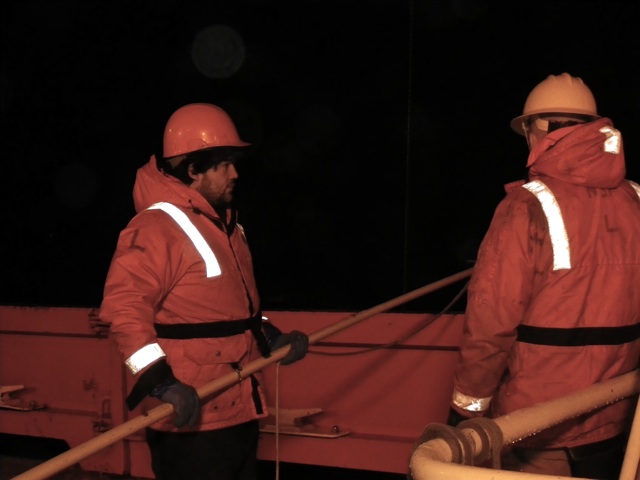
Bringing in the dredge at night. Floodlights and a heated back deck mean that we can work around the clock to collect samples (R. Waller).

Thursday, May 19, 2011

To the Galley

May 18th

As we steam through day and night up to our elbows and knees in biological gunk, amazing sea life and fossil coral, we all look to the galley to keep up our energy. It is a magical wonderland of all things tasty. The galley is where the day starts and finishes. It is the one room without a monitor of the ships statistics and thus becomes the best friend of tea-breakers and a safe-haven for the overworked. The galley is so important that our body clocks are becoming acutely tuned to opening hours, reading: breakfast-like food break with cake, snack, cake with lunch, dinner and cake, snack (cake), midnight rations, cake, bed.

As indicated above, the galley excels itself in the sweet treat department. Fresh cakes, bakes, biscuits seem to appear as if from nowhere at least twice daily. Once you step inside those four walls there is no escape, be it only for a simple cup of tea, you can guarantee leaving with a guilty look and a chocolate smear on your top lip which you are ‘just saving for later’ on questioning. It has now become standard practice to sneak from the lab, skulk down the hallway and into the galley to try and catch the cookies as they come freshly out of the oven. Here is a lost boy’s feast of toffee flans, pecan pies, macaroons, berry cheese cakes, peach surprise, ice cream cake, custard…..the list goes on. The fizzy drinks flow freely and most importantly for us Brits, so does the tea.

A quirk of the shift system (12 hours on, 12 hours off) provides the perfect opportunity to guzzle anything on offer for whichever meal tickles one’s fancy. Most folk are so confused they don’t pay any attention to other people’s eating schedules, providing the perfect cover for feasting on chips and cake for breakfast, roast potatoes at every lunchtime, and pancakes with bacon and maple syrup for dinner. That child-like desire to do what shouldn’t be done takes over and all basic food rational fades into memories of a mystery world where the ground remained still, where trees grew and the sun shone…..and where there were no thruster engines to wake you up half way through your ‘off’ shift. Dieters beware, this is not place for the faint hearted…..I’m off for a cup of tea.

By Suzy

Weather: temperature 31°F; windchill 5°F; windspeed 10-15 knots; snow!


The team sitting down for a well-earned meal in the galley (A. Margolin).


A montage of desserts on board the Palmer: something for everyone! (A. Margolin).


Shannon and MT Stian bringing in another dredge (R. Waller).


Sebastian getting ready to “hook” the dredge, in order to bring it safely on board (R. Waller).

Wednesday, May 18, 2011

All that water in the ocean …

17th May 2011

Being out in the Southern Ocean on a ship has one thing in common with every other seagoing expedition: there is water all around us! It is the wonderful medium we are sailing on, but it is also the ‘air’ the corals breathe. Modern corals build their skeleton out of the ingredients they find in seawater today, and the fossil ones record the seawater chemistry of the past in their skeletons.

In the global ocean each water mass has distinctive physical and chemical properties. If we can measure these properties precisely enough, we can distinguish the different water masses from each other. Here in the Drake Passage we have a set of water masses that play an important role when it comes to understanding the modern ocean circulation that transports heat and carbon around the globe. This pattern of ocean circulation has been different in the past, and it plays an important role in understanding climate change.

But let’s get back to the water issue … In order to make meaningful interpretations of past water chemistry recorded in coral skeletons, we first need to get a good handle on the modern water chemistry. This is one of the reasons why we collect quite a bit of water on this cruise as well. We have two ways of doing so. The standard way of collecting water is to use the ship’s CTD. This is a big carousel with a central unit to measure conductivity, temperature, and depth (CTD), as well as oxygen content, and fluorescence. It has 24 bottles attached to it, which have lids at the top and the bottom that can be opened and closed remotely. All bottles are open when the CTD is lowered into the ocean, and we can ‘fire’ the bottles (close them) at any water depth we like on the way up. The second means we have to collect seawater is from similar bottles, attached to the towed camera system we use to take pictures of the seafloor.

Once the water is onboard we take samples for a large array of chemical measurements ranging from dissolved carbon and other nutrient concentrations, to samples for isotopic measurements of various elements. The only measurement we do right here on the ship is to determine the alkalinity of the water samples. But this is a topic David Case, one of the graduate students on our expedition, will explain in more detail in one of the upcoming blogs.

Today was a great day, as we got our second CTD. Today was also squish cup time! You have no clue what I am talking about? They are great souvenirs scientists like to produce during the process of water sampling, and here is how the story goes… What you need is a white cup made out of Styrofoam, a good selection of colorful sharpie pens, and some creativity. The decorated cup then goes into a meshed bag, which gets attached to the CTD, and descends to the deep ocean. As the pressure increases with water depth, all the air is squeezed out of the cup and it is shrunk to a much smaller size. It’s really a great souvenir to take home and you can see some examples in the pictures.

By: Tina

Weather: temperature 35°F; windchill 5°F; windspeed 25 to 30 knots; cloudy, windy, with some precipitation


Sandy deploying the CTD from the “Baltic Room” of the Palmer (M. Escolar).


MT Stian teaches the night watch how to prepare a CTD for deployment (R. Waller).


Tina sampling the CTD (A. Margolin).


Kate Sampling the CTD (T. van der Flierdt).


Squish cups!! There are some cups unsquished in the background as a comparison (A. Margolin).

Tuesday, May 17, 2011

Seafloor Photography: Imaging the Ocean’s Secrets

May 16th 2011

One of the major research goals on this cruise is to examine the biodiversity and biogeography of corals across the Drake Passage. We are doing this in two ways on this expedition – the first is through physical sampling, such as trawling, dredging and coring; and the second is by taking images of the seafloor using the two camera systems we have onboard. Though as a biologist, having your hands on actual samples is the ultimate goal, sometimes there are better ways to examine the diversity of what lives on the seafloor than by collections alone.

Though underwater camera systems have been used in the ocean for many years, the advent of digital photography has seen a boom in both the number of systems and the sheer volume of image data available to us. On the ARV NB Palmer right now we have a TowCam and a DropCam, both of which have already been deployed and brought us fantastic photos of Burdwood Bank – our first sample area which we left a few days ago. The TowCam is a towed camera system – pulled behind the boat for 3-4km distance, and “flown” just 5m off the seafloor – this system brings back around 2000 images from each tow, showing us both what the ocean floor looks like, and what animals live there.

This system is great for giving us an overall look at what is there, but for a closer peek, we deploy the DropCam. While the boat is holding still we drop this camera to just 2m off the seafloor where a trigger weight is tied off. When this weight hits the seafloor, it takes a photo, we then pull it up a few meters, let the boat move, then drop it back down again to take another. In this way we “bounce” across seafloor features. Though this system can’t cover the large distances the TowCam can, it does take high resolution close up pictures, allowing us to identify more of the animals and relate that to what we see in the TowCam images and also to what we collect in our trawls. These two systems compliment each other and allow us biologists to see not only how diverse and abundant our corals are, but also how these animals live in their natural habitat on the deep-sea floor.

By: Rhian

Weather: Temperature 37°F, Windchill 16°F, Windspeed 15-20 knots, cloudy with sunny intervals


The WHOI TowCam is deployed from the Starboard A-frame by our MPC, Skip (L. Robinson).


ET Sheldon works tirelessly to get the DropCam ready for its first deployment on Burdwood Bank (A. Margolin).


Stian, Ben and Marc deploy the DropCam early in the morning at Burdwood Bank (R. Waller).


Why we biologists love deep sea images – on the left is a Thouarella sp. bottlebrush coral collected by the trawl and on the right is an image taken by the TowCam showing lots of corals all living together around a boulder alongside other species of coral and coral (NBP11-03)


An image from the DropCam, showing lots of corals and anemones living at 800m depth on Burdwood Bank (NBP11

Monday, May 16, 2011

Over to Laura…

May 15th 2011

Here we are in the middle of the Drake Passage, half way between the southern most tip of South America and Antarctica. Even though we are far from land, we are safely in the hands of our wonderful ship’s crew - so much so it easy to forget how far away we are as we make the ship our home for the next month. Three years ago we were here on the same boat on an exploratory expedition to collect deep-sea corals in the Drake Passage. Since then we have been looking forward to coming back to answer all the questions we came up with as we looked at the samples we collected. Why do corals live in the Southern Ocean? Where are they located? Why are some only found in their fossil forms, whilst some are only found live? We put together a plan, describing why we wanted to come back, and the National Science Foundation gave us a month long cruise to complete our project.

We have lots of projects going on, so today I will tell you why we are collecting fossil corals. The Southern Ocean is a really important part of the climate system, so we want to know how it has behaved in the past, when the Earth’s climate was very different. Of course it is very difficult to work out what the ocean was doing before people started to measure things like the temperature of the water. The skeletons of the fossil corals that we are collecting can help us with this problem. We can work out the age of each fossil coral using radioactive decay, and then we use other chemicals in the skeletons to find out what the ocean was doing when the coral was alive. In a way we can think of the coral skeleton as a recording device: when they grow they capture information about the water they are living in, when they die they lie on the seafloor waiting for us to come along, pick them up and play the record. We think that the corals we have collected so far will cover an age range all the way from today back to more than sixty thousand years age. What we would really like to do is find corals from different locations and with different ages and use them to build up a picture of what the Southern Ocean has been doing over tens of thousands of years. This analysis will take us a long time after the cruise, so for now we are sorting and packing them carefully so that when we get back we can get to work quickly.

So far we have been out for less than a week, but we have already made some really great progress – we spent the first few days on the shelf and slope area off South America. We have already collected hundreds of fossil corals all the way from 300m to 2000m below the surface of the sea. One of the reasons we are doing so well out here is because of the passion with which everyone is working towards making the cruise a success. It is truly thrilling to be out here with such a great group of people – despite working 24 hours a day everyone keeps smiling as the samples come on deck.

By: Laura

Weather: Temperature 36°F. windchill 5°F, wind speed 30 knots, cloudy


A tray full of fossil Balanophyllia corals collected as part of a fantastic dredge at Burdwood Bank from about 750m water depth (A. Margolin).


Three examples of fossil Flabellum corals, from pristine (left), through normal preservation, to really old and corroded (right). We collect fossils from all ages possible, so we can understand changes in the Southern Ocean over a wide time range (A. Margolin).


Kais and Michelle collecting fossil (and live) corals from a dredge a couple of days ago (R. Waller).


Laura giving a talk this morning about her work on deep-sea corals (A. Margolin).


Ben driving the Towcam this evening (A. Margolin).


Sediment sampling: the business of collecting mud and sand

14th May 2011

Collecting mud… can’t be that hard, can it? Over the past couple of days, we have been trying various ways of collecting sediments from Burdwood Bank. We tried box coring first: this is when a big metal box is winched down to the seafloor and into the sediments, where large jaws are triggered to close and trap whatever mud and sands are in the box. Unfortunately, these didn’t work here – perhaps it was the wrong type of sediment, or perhaps the seas were too rough. Our next tactic was to use a kasten core – this is a long metal box, weighted down heavily, that is sunk into the seafloor and winched up, hopefully bringing with it a long column of sediment. This time we were more successful, retrieving about a foot of sediment containing sands and corals.

Kais Mohamed Falcon is the scientist on board heading up the sediment collection efforts….

“Obtaining sea-floor sediments from hundreds or thousands of meters deep is a tricky job. The sediment type has to be right so the sampling device, or corer, we are using does the job. Mud usually is easier to sample since the corer penetrates easily into it. Sandy and gravelly sediments usually are more difficult to obtain, because the corer usually gets stopped a few centimeters into it. Imagine pushing a tube through wet sand…you probably wouldn’t go further than a 4 or 5 centimeters, whereas in mud you probably would go all the way through it.

In addition to the sediment type, from which we normally have information provided by previous expeditions, nautical charts or just intuition based on the bottom topography, many other factors influence the outcome of each coring attempt. Unsteady seas pulling from the wire and unbalancing the corer, arrival of the corer at an angle with the bottom or just hitting a rock can ruin a coring attempt. It’s like trying to hit the sidewalk pavement with a long straw from the top of the Empire State Building with your eyes closed…you could easily hit the road, a car, people or a parking meter”

“When the corer comes back on board, there is always excitement on deck. Has the corer been damaged jeopardizing future coring attempts?, has it been successful in obtaining sediment?, how much sediment has been recovered?, what is in it?, how old it is?...this is the moment when exciting science begins!”

And now we’re off in transit again, heading towards the Shackleton Fracture Zone.

By: Kate and Kais

Weather: 38°F, windchill 22°F, wind 5-10 knots, foggy


Sampling from the Nathaniel B Palmer on a beautiful sunny day in the Southern Ocean (D. Case).


The marine techs deploying the box core. The box, mounted on a yellow frame, sinks into the sediment, where jaws are triggered to shut and trap sediment inside (R. waller).


The contents of the kasten core, recovered a few days ago (K. Falcon).


Geologist Kais taking some time to take some photos of the scenery (A. Margolin).


A misty morning view from the Palmer (S. Jennions).

Mapping the Ocean Floor

13th May 2011

Hello, from the multibeam desk! My name is Shannon and I am an undergraduate student at the College of Charleston in Charleston, SC. This is my fifth cruise participating as a mapping technician. I first got interested in mapping the seafloor during my sophomore year at college, when a professor of mine took me on a two week cruise from Charleston to around Nova Scotia. Learning this tool has been a fantastic opportunity for me, as it allowed me to participate in multiple cruises all over the world. I have been able to travel to Key West, Hawaii, Guam, Indonesia and now Chile and the Southern Ocean all because of learning this tool two years ago.

For those of you who have not had the pleasure to work with multibeam, it is a sonar that sends down beams of sound that hit the seafloor and then reflects back to a receiver on the ship. The acquisition system uses the travel time of sound in water to determine the depth from that “ping”. All these individual pings can then be used to construct a bathymetric map (e.g., topography of the seafloor). While as mappers we do not bring up colorful animals or fossils, we produce colorful maps, which in my opinion, is just as exciting!

As a mapper, one must be able to sit at the computer for long periods of time. On this cruise I am working between 0100 and 1300. I find tiny dots conveying information about the seafloor very interesting, and get so excited when we find new features on the seafloor, or fill in areas that have not been covered during previous cruises. Some find it silly that I can get so enthused by little dots on the screen, but these dots hold the key to so much more information. Multibeam mapping can be used to chart the waters, to discover new features that were thought to not exist before, or to find sunken ships or pipe lines. We can discover information about the seafloor at depths exceeding 8000m! Down here in the Southern Ocean, most of the seafloor that we are mapping has never been mapped before. I am so excited to map new areas of the seafloor while aboard the R/V Nathaniel B. Palmer and to see what questions will arise due to these hundreds of dots on a computer screen.

By: Shannon

Weather: 24F, 17 knots of wind and sunshine!


Shannon shows Kathy through some of the newly acquired multibeam (R. Waller).


Three-dimensional view of the seafloor acquired during the NBP1103 cruise aboard the Nathaniel B. Palmer generated in CARIS HIPS and SIPS 7.0 ©


Sometimes we do let Shannon away from her desk. Here she is helping sort a dredge sample that contained a wealth of corals (R. Waller).


Yesterday we did a Kaston core that collected around 2 ft of sediment and corals from 300m. Here Kais begins to process the sample.


This little Galatheid squat lobster came up in an early morning trawl from 800m! (R.Waller).